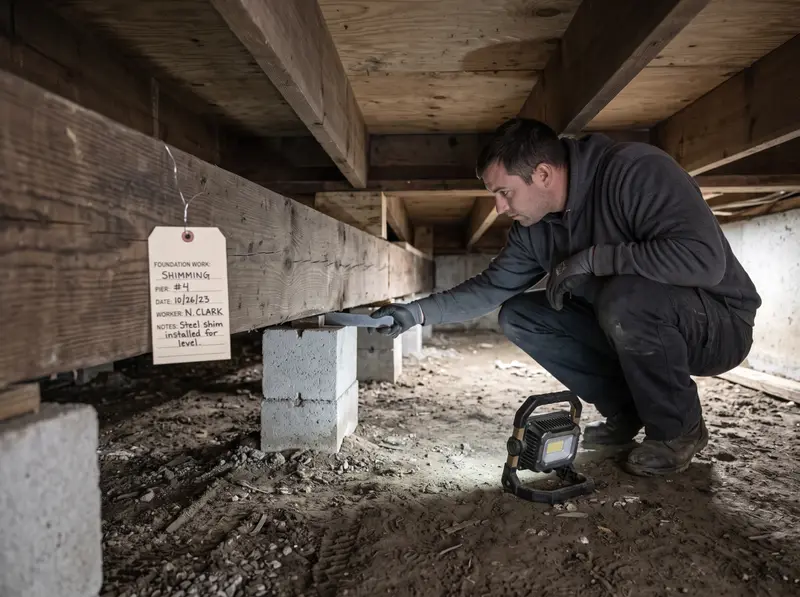
Pier and beam houses are leveled by adjusting the supports under the floor framing, which is far cheaper than slab work when the piers themselves are sound.
Is it the framing, the piers, or the ground under them?
A springy or sloping floor in an older house has three possible causes stacked on top of each other, and they cost very different amounts to fix. The cheapest is adjustment. If the piers are sound and the beams are sound, shimming brings the floor back and it is the least expensive item anywhere on this site. The middle case is framing: sill plates, beams and joist ends rot where water has been getting in, most often near a bathroom or a leaking hose bib, and that timber has to come out and go back. The expensive case is the ground. If the piers themselves have settled, adjusting the top of a support that is sinking buys a year. Someone has to get under the house and look, and any quote written without that is a quote for the cheapest of the three regardless of which one you have.
What a Houston crawl space is up against
The dominant soil under Houston is rated Somewhat poorly drained, with the shallowest mapped water table around 4.7 inches. A crawl space sits directly in that. Ground moisture rises as vapor whether or not liquid water appears, and the wood at the bottom of a house takes it on first: sills, joist ends, pier caps. A floor that feels soft is usually reporting on humidity under it.
The jobs this covers, and what each one costs to get wrong
Shimming and Re-Leveling
Adjustment at the top of existing piers and posts, with shims added or replaced until the floor framing sits level again. It is the routine maintenance action on a pier-and-beam house, and it is the cheapest thing on this list when the piers themselves are sound.
What moves the price. Crawl space clearance above everything else. A tall crawl is ordinary work. A tight one is slow, hot and priced accordingly. The number of support points and how far out of level they sit does the rest.
When Shimming and Re-Leveling is the wrong answer. If the piers themselves have settled or the beams have rotted, shimming levels a floor on top of a failing support. Have the supports looked at before paying to adjust them.
Sill, Beam and Joist Repair
Replacement of rotted or insect-damaged framing where it bears on a pier, including sill plates, beams and the joist ends above them. It is what a soft or springy floor usually turns out to be in an older pier-and-beam house, particularly near a bathroom or a leaking hose bib.
What moves the price. How much has to come out, and whether the house must be temporarily supported while it does. Working around plumbing and ductwork in a low crawl adds hours to every member replaced.
When Sill, Beam and Joist Repair is the wrong answer. If the framing is sound and the floor still moves, the problem is the pier under it or the ground under that. Replacing good timber is an expensive way to find that out.
Crawl Space Moisture Barrier
Sheeting laid across the crawl space ground and lapped up the piers, so ground moisture stops evaporating into the framing above it. It is worth doing where the crawl space smells damp, where ducts sweat, or where framing repairs have just been paid for and should last.
What moves the price. Area and clearance. The material is not the expensive part. Working in a crawl you cannot sit up in is, and debris that must come out first is a separate line.
When Crawl Space Moisture Barrier is the wrong answer. If standing water appears after rain, a barrier covers it rather than removing it. Deal with where the water is arriving from first, or you have wrapped the problem in plastic.
Get an estimate in Houston
None of this can be priced from a description. Three things decide it. What the ground does with water. How much fall the site has. Where the water may go at the end. All three are facts about an address, and none of them show up in a photograph. Send the address and what you are seeing. Someone who does this work in Houston takes it from there. If it turns out to be a cheaper job than the one you came here for, that is worth hearing before anyone digs.
Houston Foundation Repair Co services.
Read what a Houston foundation repair job costs before calling anyone, and check the Houston Foundation Repair Co service area to see whether your street is covered.
Back to Houston Foundation Repair Co.
The ground under Houston
Questions people actually ask
How often does a pier and beam house need re-leveling?
There is no schedule. It is driven by how the ground under the piers behaves, so a house on stable soil with good drainage may go decades and one on clay with water against it will not.
Why is my floor springy in one room only?
Spring is usually framing rather than foundation. A joist or a beam end that has softened flexes under load while the piers under it are perfectly sound, which is why it is localized.
Does a crawl space need a vapor barrier?
It helps where ground moisture is evaporating into the framing above. It does not help where liquid water is arriving after rain, and laying one over standing water wraps the problem rather than removing it.
Is pier and beam worse than slab?
Neither is worse. A pier and beam floor is adjustable, which is a real advantage, and it is accessible for plumbing work. It also has framing that can rot, which a slab does not.
Can I level a pier and beam house myself?
Shims are simple and the consequences of getting it wrong are not. Lifting unevenly cracks plaster, jams doors and can split a beam, and the work happens in a space most people cannot stand up in.
Trusted across Houston, Texas and Harris County
What this site is good for
-
Residential and commercial
A house with a wet basement and a site with standing water on a hardstanding are different jobs at different scales. Both are covered, and the pages say which is which.
-
Free, and nothing attached
Working out which job you actually have costs nothing and commits you to nothing. There is no fee to you at any point, because this site is paid by the contractor and not by you.
-
Your details are not for sale
An address sent here goes to a foundation repair contractor working in the area. It is never sold, and never passed to a second firm.
-
Permits named, not glossed
The pages name the authority that issues the permit for this work and the inspection that goes with it, so you can ask to see one before the first cut.
-
Every figure sourced and dated
Soil, rainfall and housing figures each name where they came from and when they were retrieved. Where a published estimate carries a margin of error, the margin is shown too.
-
One town, covered properly
This site is about one place and the towns within a short drive of it. It is not a national directory with a city name dropped into a template.
-
An open pier cut past the slab edge. How deep it has to go is decided by the ground, not by the house. -
The lift itself, read off a dial indicator. Deciding where to lift is the part that takes the measuring.


Ground that is saturated has nowhere to put the next storm, and water sitting against a wall keeps working on it.
What happens after you send an address
-
The address first, and only then who you are
The first screen asks for the property address and checks that a contractor covers it. Only if one does does it ask for a name, a phone number and an email — there is no point taking your details to tell you nobody serves your street.
-
Your details are not for sale
It goes to a foundation repair contractor working in Houston. The details are never sold, and never passed to a second firm.
-
No cost, and nothing attached
There is no fee for sending an address and no obligation that follows from it. Deciding the work is the wrong work is a perfectly good outcome.
-
Who does the work
An independent foundation repair contractor, not the publisher of this site. Who runs this site, and where every figure on it comes from, is set out on the about page.