
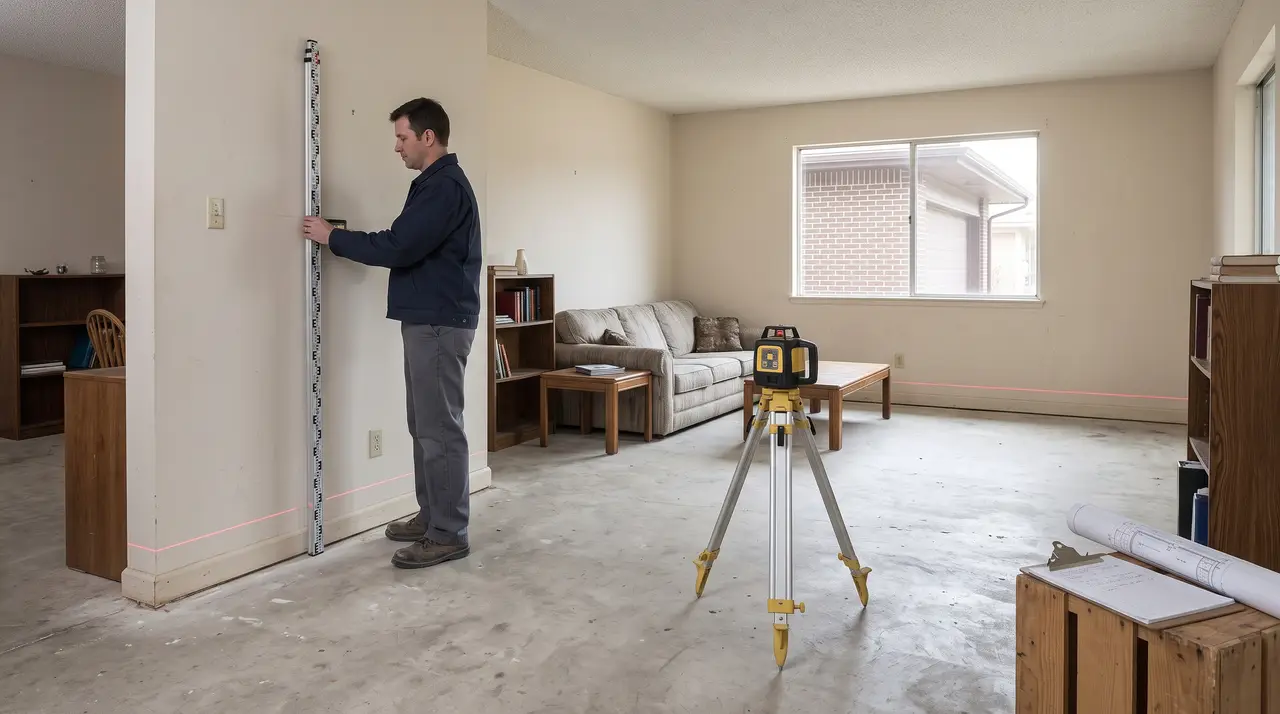
Settling is the ground consolidating under a house and it slows down. Sinking is a section still going and it does not. Sagging is the framing between supports, not the foundation at all. Measuring the floor tells you which, and nothing you can see from outside does.
Settling is the ground consolidating, and it slows down
Every house settles. A new structure puts load on ground that has never carried it, the soil compresses under that load, and the house comes down a little — most of it in the first few years, decreasing after that. On a house of any age this is finished history, not a live problem.
What makes settling recognizable is that it decelerates. A crack that opened five years ago, has been photographed twice since, and is the same width today is a record of movement that already happened. The repair for that is cosmetic: fill it, paint it, and watch it.
The trap is that the word gets used for the opposite case. “Your house is settling” is said to homeowners whose houses are in fact still moving, because it sounds routine. The distinction is not rhetorical and it is not a judgment call — it is two measurements taken months apart.
Sinking is a section still going, and the clay decides where
A house that is sinking has one part of it moving relative to another, and it is still moving. On expansive clay this is rarely uniform: the side under a large tree dries and shrinks faster, the side against a leaking supply line stays swollen, and the difference between them is what opens a wall.
The tells are about direction and rate rather than size. A door that binds a little harder every season for two years. A crack that is wider at the top than the bottom and has grown. Brick mortar that has opened in a stair-step up one corner. A floor that reads downhill in one direction, consistently, across several rooms.
This is the case piers are for, and it is the case where the depth matters. A pier works by reaching ground that does not change volume with the season and transferring the load onto it — so the honest quote does not name the depth in advance, because that depth is found as each pier goes down.
Sagging is the framing, and it is usually the smallest job of the three
A floor that bounces underfoot or dips toward the middle of a room is generally not a foundation problem at all. It is the framing between the supports — a girder span that is too long for the load, a post that has rotted at its base, a joist that has pulled away where it bears.
This matters because it is the cheapest of the three to put right and the easiest to misattribute. A homeowner who feels the floor move and calls for a foundation quote can end up being priced for piers around the outside of a house whose problem is a failed post in the middle of the crawl space.
The way to tell is where the movement is. A sagging floor over a crawl space has a low point somewhere inside the room, away from the walls. A foundation problem shows at the perimeter first — at the door frames, at the brick, at the slab edge. If the middle of the room is the low point and the walls are square, look underneath before looking outside.
The measurement that separates them
One reading settles the question, and it is the same one in all three cases: relative floor elevations taken across the whole structure and written down, with the date on them.
A single survey tells you the shape of the movement — where the high point is, how far the low point has dropped, and whether the fall is at the perimeter or in the middle of a span. That alone separates sagging framing from a moving foundation, because the two make different shapes.
A second survey, taken a season later, tells you the rate, and the rate is what separates settling from sinking. Ground that has finished consolidating gives you two readings that agree. A section still going gives you two that do not.
That is why the sequence is measure, then quote, and not the other way round. A number can be handed to a second contractor and checked. An opinion that a house “looks like it has moved” cannot, and it is the thing homeowners end up paying twice to resolve.
When you do not need foundation repair
Two things get mistaken for foundation failure more than anything else. A hairline crack in mortar or brick veneer that has been there for years and has not widened is a finish crack, not a structural one. And a door that binds in late summer and swings free after a wet winter is following the season: clay soil swells when it takes on water and shrinks when it dries, and the house moves a little with it. Neither one is a reason to put piers under a house, and a contractor who quotes on either without measuring first is selling you the wrong job.
Two checks worth making before anyone quotes you.
- Date the crack. Mark both ends with a pencil, write the date on the wall beside it, and measure the width against something known — a dime is about a sixteenth of an inch. Look again in three months. A crack that has not moved is not an active one, and no pier will make it narrower.
- Watch one door through a season change. A door that sticks in the dry months and clears after a long wet spell is tracking the weather, not a failing foundation. A door that has bound a little harder every season for two years is the one worth an inspection, and it is the pattern to describe when you call.
If both checks come back quiet, wait a season and look again before spending anything larger.
Read what a Houston foundation repair job costs before calling anyone, and check the Houston Foundation Repair Co service area to see whether your street is covered.
Back to Houston Foundation Repair Co.
Questions people actually ask
Is foundation settling normal?
Initial settlement is normal and it decelerates. Movement that is still going years after the house was built is not settlement in that sense, whatever it gets called, and the difference is two measurements taken months apart rather than a judgment about the house.
How do I know if my foundation is still sinking?
Mark and date a crack, photograph it with something of known width beside it, and look again in three months. Alongside that, get relative floor elevations taken and repeated a season later. Movement that has stopped gives you readings that agree.
Are sagging floors a foundation problem?
Usually not. A floor that dips toward the middle of a room is generally the framing under it — a long girder span, a failed post, a joist that has dropped at its bearing. A foundation problem tends to show at the perimeter first.
Can a house stop sinking on its own?
A house on expansive clay can appear to stop, because the soil swells back in a wet season and lifts it. That is the cycle rather than a repair, and reading it as a recovery is the most common reason a homeowner defers work that is still needed.
What is the difference between settlement and heave?
Settlement is the house going down as soil compresses. Heave is the house going up as clay takes on water and expands. Both crack walls and they can happen at different corners of the same house in the same year, which is why the direction of the movement is part of what a survey establishes.
Ground that is saturated has nowhere to put the next storm, and water sitting against a wall keeps working on it.
What happens after you send an address
-
The address first, and only then who you are
The first screen asks for the property address and checks that a contractor covers it. Only if one does does it ask for a name, a phone number and an email — there is no point taking your details to tell you nobody serves your street.
-
Your details are not for sale
It goes to a foundation repair contractor working in Houston. The details are never sold, and never passed to a second firm.
-
No cost, and nothing attached
There is no fee for sending an address and no obligation that follows from it. Deciding the work is the wrong work is a perfectly good outcome.
-
Who does the work
An independent foundation repair contractor, not the publisher of this site. Who runs this site, and where every figure on it comes from, is set out on the about page.