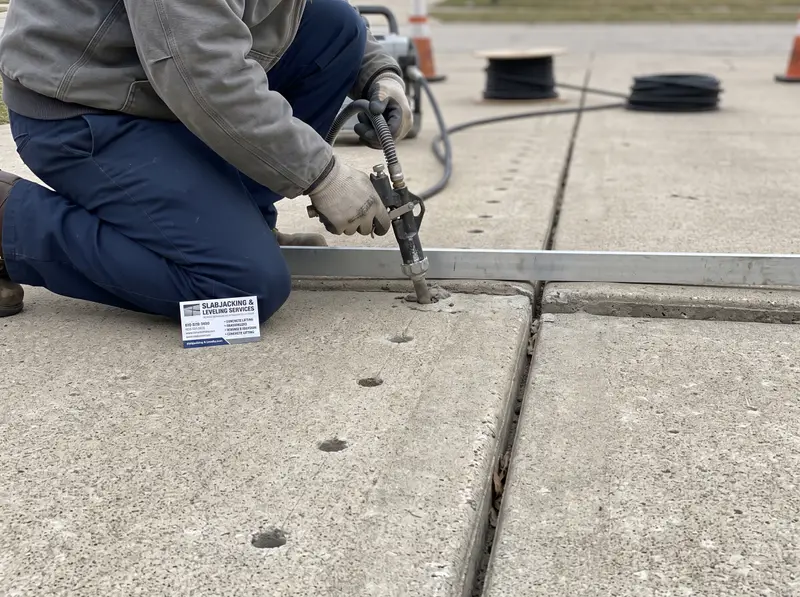
Concrete leveling raises a sunken slab by filling the void underneath it, either with a cement slurry or with expanding foam, and the concrete itself is reused.
Lift it, or replace it?
Lifting works when the concrete is still one sound piece that has dropped. It stops working when the slab has broken into sections that move independently, because raising them re-levels the break rather than repairing it. Walk the slab and look at the cracks rather than the height. A slab with one or two clean cracks and no rocking is a lifting job. A slab that moves under your foot, or that has spalled and lost surface across its width, is at the end of its life and lifting only postpones the replacement by a season or two. Then there is where the water goes. Flatwork that slopes back toward the house is doing active damage to the foundation, and correcting that slope is worth more than the trip hazard is. Price the lift and the drainage together, because the second one is why the first one matters.
That choice has a page of its own: Mudjacking vs Foam Lifting in Houston, TX.
Why slabs and driveways in Houston lose their support
Water moves through the soil mapped under Houston at between 0.03 and 3.97 inches an hour. That spread is the whole problem for flatwork. Where water drains slowly it sits and softens the bearing layer. Where it moves fast it carries fines away and leaves a void. Either way the slab is spanning air it was never built to span, and the crack that follows is the symptom.
The jobs this covers, and what each one costs to get wrong
Mudjacking and Slab Leveling
A sand and cement slurry pumped through holes in a sunken concrete slab until it lifts back to grade, then the holes patched. It is the right job for flatwork that has dropped — a patio, a garage floor, a walkway — where the concrete itself is still sound.
What moves the price. The void under the slab, not the area on top of it. Two slabs the same size take very different volumes. Pump access and how far the truck can get from the work also move it.
When Mudjacking and Slab Leveling is the wrong answer. If the slab is broken into several pieces that rock independently, lifting them re-levels the break without fixing it. Replacement is often cheaper once a slab has lost its integrity.
Polyurethane Foam Lifting
A two-part expanding foam injected under a slab through small ports, lifting it as the foam expands and cures. It suits slabs where weight matters, where the drill holes must be small, or where the surface has to carry traffic again the same day.
What moves the price. Foam volume and density. A large void takes a great deal of material, and higher-density foam for a driveway costs more per unit than a light fill under a walkway.
When Polyurethane Foam Lifting is the wrong answer. Where the void is large, open and easy to reach, a slurry fill may cost less for the same lift. Foam buys speed, small holes and low added weight, and you should be paying for at least one of those.
Driveway and Walkway Leveling
Lifting and re-bedding the outdoor flatwork around a house so the joints sit flush and water runs away from the structure. It matters for two reasons at once. A raised joint is a trip hazard, and flatwork sloping toward the house sends water where it does the most damage.
What moves the price. The number of separate panels and how far each has moved. Long driveways move in sections, and each section is its own lift. Existing control joints make the work cleaner and cheaper.
When Driveway and Walkway Leveling is the wrong answer. If the slab is spalling and cracked across its width, lifting preserves a surface that is already failing. Price replacement alongside, because the lift may only postpone it by a season or two.
Get an estimate in Houston
None of this can be priced from a description. Three things decide it. What the ground does with water. How much fall the site has. Where the water may go at the end. All three are facts about an address, and none of them show up in a photograph. Send the address and what you are seeing. Someone who does this work in Houston takes it from there. If it turns out to be a cheaper job than the one you came here for, that is worth hearing before anyone digs.
Houston Foundation Repair Co services.
Read what a Houston foundation repair job costs before calling anyone, and check the Houston Foundation Repair Co service area to see whether your street is covered.
Back to Houston Foundation Repair Co.
The ground under Houston
Questions people actually ask
How long does lifted concrete stay level?
It stays until the ground under it moves again, which is the same thing that dropped it. Correcting the drainage that saturated the soil is what makes a lift last rather than repeat.
Are the holes visible afterwards?
Yes, though foam ports are smaller than slurry holes. Both are patched and both remain findable on close inspection. Anyone promising an invisible repair on existing concrete is overselling it.
Can a cracked slab be lifted?
One or two clean cracks, usually. A slab in several pieces that rock independently, no. Lifting those re-levels the break and leaves the break, and replacement is often cheaper within a couple of years.
Is foam always better than slurry?
No. Foam buys small holes, low added weight and same-day traffic. If none of those matter for your slab, a slurry fill may cost less for the same result, and you should be paying for at least one of the three.
Does lifting a driveway fix water getting into the garage?
Only if the water was arriving because the slab sloped inward. If it is coming off the roof or down the drive from the street, the slope was not the cause and the lift will not stop it.
Trusted across Houston, Texas and Harris County
What this site is good for
-
Residential and commercial
A house with a wet basement and a site with standing water on a hardstanding are different jobs at different scales. Both are covered, and the pages say which is which.
-
Free, and nothing attached
Working out which job you actually have costs nothing and commits you to nothing. There is no fee to you at any point, because this site is paid by the contractor and not by you.
-
Your details are not for sale
An address sent here goes to a foundation repair contractor working in the area. It is never sold, and never passed to a second firm.
-
Permits named, not glossed
The pages name the authority that issues the permit for this work and the inspection that goes with it, so you can ask to see one before the first cut.
-
Every figure sourced and dated
Soil, rainfall and housing figures each name where they came from and when they were retrieved. Where a published estimate carries a margin of error, the margin is shown too.
-
One town, covered properly
This site is about one place and the towns within a short drive of it. It is not a national directory with a city name dropped into a template.
-
An open pier cut past the slab edge. How deep it has to go is decided by the ground, not by the house. -
The lift itself, read off a dial indicator. Deciding where to lift is the part that takes the measuring.


Ground that is saturated has nowhere to put the next storm, and water sitting against a wall keeps working on it.
What happens after you send an address
-
The address first, and only then who you are
The first screen asks for the property address and checks that a contractor covers it. Only if one does does it ask for a name, a phone number and an email — there is no point taking your details to tell you nobody serves your street.
-
Your details are not for sale
It goes to a foundation repair contractor working in Houston. The details are never sold, and never passed to a second firm.
-
No cost, and nothing attached
There is no fee for sending an address and no obligation that follows from it. Deciding the work is the wrong work is a perfectly good outcome.
-
Who does the work
An independent foundation repair contractor, not the publisher of this site. Who runs this site, and where every figure on it comes from, is set out on the about page.