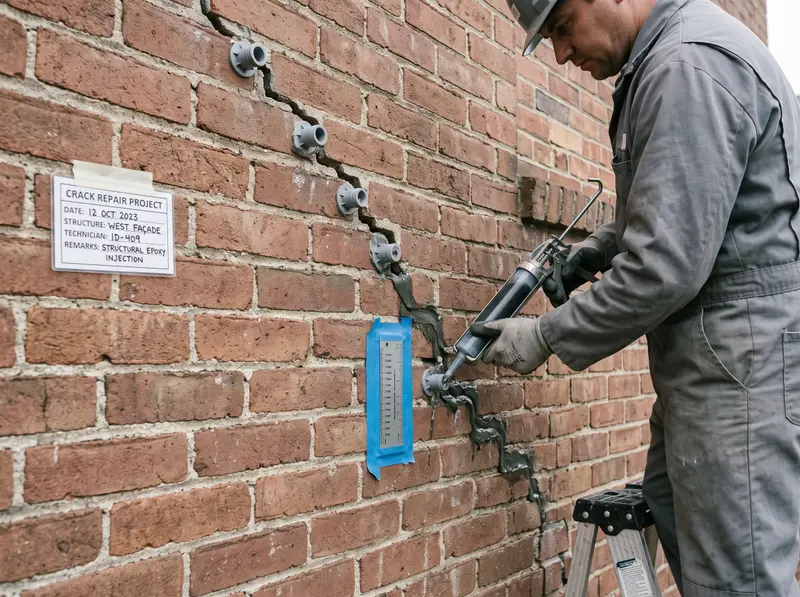
Cracks are repaired once movement has stopped. Sealing one that is still opening buys a season and removes the only thing telling you how fast the house is moving.
Is the crack still moving, or is it a record of something that already happened?
This is the whole decision and it is not answerable by looking. A crack that has been the same width for three years and a crack that opened last spring look identical in a photograph, and only one of them should be filled. What separates them is measurement over time. A dated photograph with a ruler in it, taken a few months apart, costs nothing and answers it. So does an elevation survey, which additionally tells you whether the movement is settlement or heave, and those want opposite repairs. Once you know it has stopped, the crack is a path for water and air rather than a symptom, and injection is the right job. Once you know it has not, filling it is the wrong purchase and the money belongs under the house instead.
Why cracks in Houston open and close with the season
A typical wet day in Houston drops about 5.1 inches in a day. The rare one drops 16.9 inches. That swing is the engine behind most cracks people photograph. Soil takes water on and pushes up, gives it back and drops away. Concrete, mortar and drywall record the movement because they cannot follow it. A crack that widens after a wet week and closes in August is doing exactly that.
The jobs this covers, and what each one costs to get wrong
Foundation Crack Injection
A crack filled under pressure with epoxy or polyurethane so the two faces are bonded or sealed along the full depth. It is the answer once movement has stopped and the crack is a path for water or air rather than a symptom that is still growing.
What moves the price. Length, depth and access. A crack reachable from inside a garage is cheap. The same crack behind a finished wall is priced with the demolition and the making good. Epoxy and polyurethane are not interchangeable and are not priced alike.
When Foundation Crack Injection is the wrong answer. If the crack is still opening, filling it buys a season and hides the evidence. Have the movement measured first. A sealed crack that reopens has cost you the repair and the record of how fast it moved.
Grade Beam Repair
Repair to the thickened perimeter beam a slab is poured with, where it has cracked, spalled or lost bearing. It is the right job when the damage is at the slab edge rather than in the field, which is where clay movement concentrates it.
What moves the price. How much beam is affected and what sits on it. An exposed run in a side yard is straightforward. A beam under a brick veneer wall means the veneer is part of the job.
When Grade Beam Repair is the wrong answer. If the beam is sound and the field of the slab has dropped, the fix is support under the interior, not repair at the edge. Those are opposite jobs and an elevation survey tells them apart.
Brick and Mortar Crack Repair
Repointing and stitching of stair-step cracking in brick veneer, and resetting of the shelf the veneer sits on where it has moved. It is cosmetic repair that comes after the structure is stable, not instead of it. Veneer cracks are the most visible record of movement underneath.
What moves the price. Access and match. Ground-floor work from a ladder is one price, second-story work from staging another. Matching an older mortar color and an out-of-production brick is usually the hard part.
When Brick and Mortar Crack Repair is the wrong answer. If the crack is still widening, repointing it removes the one thing telling you the house is moving. Measure first, repair second. That order is not a sales preference, it is the only way to know the repair will hold.
Get an estimate in Houston
None of this can be priced from a description. Three things decide it. What the ground does with water. How much fall the site has. Where the water may go at the end. All three are facts about an address, and none of them show up in a photograph. Send the address and what you are seeing. Someone who does this work in Houston takes it from there. If it turns out to be a cheaper job than the one you came here for, that is worth hearing before anyone digs.
Houston Foundation Repair Co services.
Read what a Houston foundation repair job costs before calling anyone, and check the Houston Foundation Repair Co service area to see whether your street is covered.
Back to Houston Foundation Repair Co.
The ground under Houston
Questions people actually ask
How wide does a crack have to be before it matters?
Width is the wrong single test. A hairline crack that is growing matters more than a wider one that has been still for a decade, which is why the measurement over time is the thing worth having.
What is the difference between epoxy and polyurethane injection?
Epoxy bonds the two faces together and is used where the crack is not expected to move again. Polyurethane stays flexible and seals against water. They are not interchangeable and are not priced alike.
Do stair-step cracks in brick mean the foundation has failed?
They mean something underneath has moved. Brick veneer is rigid and cracks along its mortar joints when the shelf it sits on shifts, so it is often the most visible record of movement, not the problem itself.
Should I repair the brick before or after the foundation?
After. Repointing first removes the record of the movement and the new mortar cracks again when the house moves further. The order is not a sales preference, it is the only way to know the repair will hold.
Can I fill a foundation crack myself?
Surface patching is within reach of most people and seals almost nothing, because a crack runs the full depth of the concrete. Injection under pressure is what reaches the rest of it, and that is equipment work.
Trusted across Houston, Texas and Harris County
What this site is good for
-
Residential and commercial
A house with a wet basement and a site with standing water on a hardstanding are different jobs at different scales. Both are covered, and the pages say which is which.
-
Free, and nothing attached
Working out which job you actually have costs nothing and commits you to nothing. There is no fee to you at any point, because this site is paid by the contractor and not by you.
-
Your details are not for sale
An address sent here goes to a foundation repair contractor working in the area. It is never sold, and never passed to a second firm.
-
Permits named, not glossed
The pages name the authority that issues the permit for this work and the inspection that goes with it, so you can ask to see one before the first cut.
-
Every figure sourced and dated
Soil, rainfall and housing figures each name where they came from and when they were retrieved. Where a published estimate carries a margin of error, the margin is shown too.
-
One town, covered properly
This site is about one place and the towns within a short drive of it. It is not a national directory with a city name dropped into a template.
-
An open pier cut past the slab edge. How deep it has to go is decided by the ground, not by the house. -
The lift itself, read off a dial indicator. Deciding where to lift is the part that takes the measuring.


Ground that is saturated has nowhere to put the next storm, and water sitting against a wall keeps working on it.
What happens after you send an address
-
The address first, and only then who you are
The first screen asks for the property address and checks that a contractor covers it. Only if one does does it ask for a name, a phone number and an email — there is no point taking your details to tell you nobody serves your street.
-
Your details are not for sale
It goes to a foundation repair contractor working in Houston. The details are never sold, and never passed to a second firm.
-
No cost, and nothing attached
There is no fee for sending an address and no obligation that follows from it. Deciding the work is the wrong work is a perfectly good outcome.
-
Who does the work
An independent foundation repair contractor, not the publisher of this site. Who runs this site, and where every figure on it comes from, is set out on the about page.