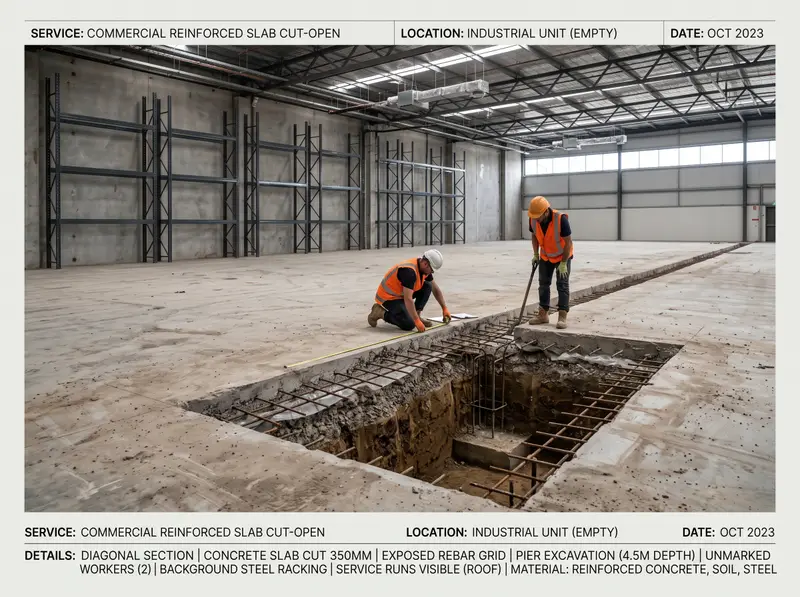
Commercial foundation work is priced from occupancy, phasing and engineered load before it is priced from area, because the building usually has to keep operating.
Is this a structural problem or a serviceability one?
The two get confused and they carry very different budgets. A structural problem means the frame is affected: the building is moving differentially and the envelope, the glazing or the connections are showing it. A serviceability problem means the structure is fine and the floor no longer meets the flatness that racking, machinery or a tenant requires. Serviceability is often a slab-only repair, and sometimes a joint and surface repair is the entire job. Structural means engineered support sized to real loads, and that starts with an assessment rather than a quote. Then phasing, which is usually the largest line and has nothing to do with the foundation. Work that must happen overnight, in sections, around a live tenant is a different price from the same work in an empty building, and any quote that does not say which it assumes is not comparable to one that does.
What a Houston commercial slab is sitting on
The dominant soil under Houston is hydrologic group C/D, mapped as Clodine-Urban land complex, 0 to 1 percent slopes. On a commercial slab that matters more than on a house. Loads are heavier and the limits are tighter. Racking, door tracks and machine bases show movement long before anyone sees a crack. A building that has to keep trading needs the work sequenced around that.
The jobs this covers, and what each one costs to get wrong
Commercial Slab Repair
Repair and support of slabs under commercial buildings, warehouses and tilt-wall structures, where loads and tolerances are not residential. It applies where floor flatness affects racking, machinery or a lease obligation rather than where a door sticks.
What moves the price. Occupancy and hours, before anything structural. Work that has to happen overnight or in phases around a tenant is priced differently from an empty building. Load requirements set the support spacing.
When Commercial Slab Repair is the wrong answer. If the complaint is cosmetic cracking in a slab that is performing, a joint and surface repair may be the whole job. Support is for a slab that has moved or is carrying more than it was designed for.
Commercial Pier Installation
Deep support installed under commercial structures, sized to engineered loads rather than to residential rules of thumb. It is the answer where a building has settled differentially and the movement is affecting the structure, the envelope or a lease.
What moves the price. Engineered load, pier count and site logistics. Equipment access around a live site, phasing around operations, and spoil handling on a paved lot all add to it.
When Commercial Pier Installation is the wrong answer. If only the floor slab has moved and the frame has not, the repair may be to the slab alone. Those are very different budgets and an engineered assessment separates them.
Get an estimate in Houston
None of this can be priced from a description. Three things decide it. What the ground does with water. How much fall the site has. Where the water may go at the end. All three are facts about an address, and none of them show up in a photograph. Send the address and what you are seeing. Someone who does this work in Houston takes it from there. If it turns out to be a cheaper job than the one you came here for, that is worth hearing before anyone digs.
Houston Foundation Repair Co services.
Read what a Houston foundation repair job costs before calling anyone, and check the Houston Foundation Repair Co service area to see whether your street is covered.
Back to Houston Foundation Repair Co.
The ground under Houston
Questions people actually ask
Can the building stay open during the work?
Usually, in phases, and that is the assumption worth confirming in writing. Phasing around occupied space is the difference between two quotes far more often than the structural scope is.
Who specifies the repair on a commercial building?
An engineer, working from loads and a survey. A contractor prices and performs what is specified. On a residential slab those can be the same conversation; on a commercial building they should not be.
Does a tilt-wall building fail differently?
Its panels are rigid and carry load to discrete points, so differential movement shows at the joints and connections rather than as a crack across a floor. What to inspect is different from a framed building.
Is floor flatness a foundation problem?
Not always. Flatness can be a finishing defect from the original pour rather than movement since. A survey against the original tolerance is what separates them, and it changes who is responsible.
How is a warehouse slab priced?
By load and joint condition more than by square footage. A slab carrying racking legs at high point loads is assessed differently from the same area of floor carrying foot traffic.
Trusted across Houston, Texas and Harris County
What this site is good for
-
Residential and commercial
A house with a wet basement and a site with standing water on a hardstanding are different jobs at different scales. Both are covered, and the pages say which is which.
-
Free, and nothing attached
Working out which job you actually have costs nothing and commits you to nothing. There is no fee to you at any point, because this site is paid by the contractor and not by you.
-
Your details are not for sale
An address sent here goes to a foundation repair contractor working in the area. It is never sold, and never passed to a second firm.
-
Permits named, not glossed
The pages name the authority that issues the permit for this work and the inspection that goes with it, so you can ask to see one before the first cut.
-
Every figure sourced and dated
Soil, rainfall and housing figures each name where they came from and when they were retrieved. Where a published estimate carries a margin of error, the margin is shown too.
-
One town, covered properly
This site is about one place and the towns within a short drive of it. It is not a national directory with a city name dropped into a template.
-
An open pier cut past the slab edge. How deep it has to go is decided by the ground, not by the house. -
The lift itself, read off a dial indicator. Deciding where to lift is the part that takes the measuring.


Ground that is saturated has nowhere to put the next storm, and water sitting against a wall keeps working on it.
What happens after you send an address
-
The address first, and only then who you are
The first screen asks for the property address and checks that a contractor covers it. Only if one does does it ask for a name, a phone number and an email — there is no point taking your details to tell you nobody serves your street.
-
Your details are not for sale
It goes to a foundation repair contractor working in Houston. The details are never sold, and never passed to a second firm.
-
No cost, and nothing attached
There is no fee for sending an address and no obligation that follows from it. Deciding the work is the wrong work is a perfectly good outcome.
-
Who does the work
An independent foundation repair contractor, not the publisher of this site. Who runs this site, and where every figure on it comes from, is set out on the about page.