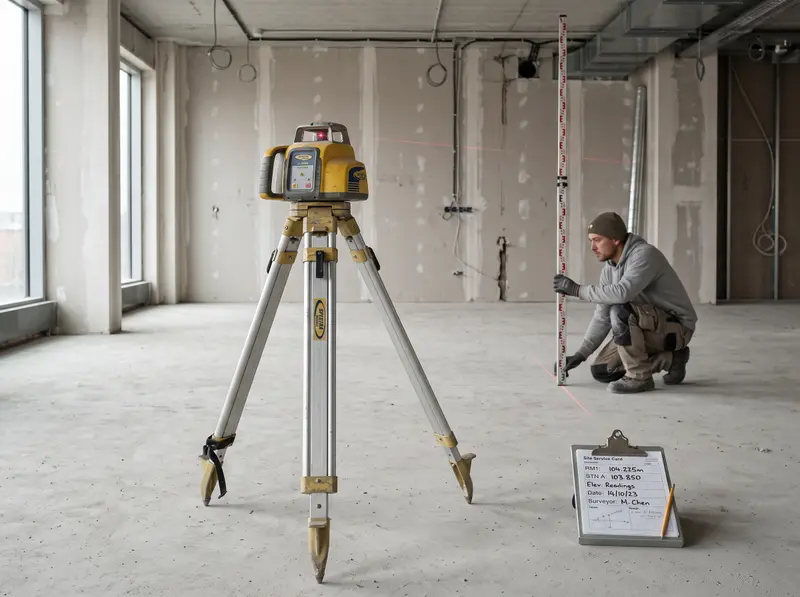
A measured survey of a typical single-story house takes one to two hours on site. Additions, split levels and pier-and-beam sections each need their own reference, so a house with several takes proportionally longer.
What a Houston survey is reading against
The readings matter here because the ground does. Up to 51% of the mapped soil is clay, in hydrologic group C/D — ground that takes up and gives back water rather than passing it through. A single set of elevations on soil like this is a snapshot of a structure that moves seasonally, which is the argument for keeping the report rather than filing it.
The reasoning behind that
The time on site is mostly the readings. Elevations are taken at points across every floor plane, and a simple rectangular house on one slab is one plane. Every addition, every step down into a sunken room and every pier-and-beam section is another, each needing its own reference before the readings mean anything. Access is the other variable. Furniture, flooring and stored belongings all hide the points a reading needs, and a crawl space that cannot be entered is a section that cannot be assessed. Clearing access before the appointment shortens it materially. Time on site is not the same as turnaround. The report — the readings, where each was taken, and the date — commonly arrives afterwards, and if a contract deadline is running that turnaround is the number worth asking about rather than the duration of the visit. If nothing arrives in writing at all, the visit produced an opinion rather than a measurement, and an opinion cannot be compared against a second reading next year.
Every question, in one place: Houston Foundation Repair Co questions.
Check the Houston Foundation Repair Co service area to see whether your street is covered.
Back to Houston Foundation Repair Co.