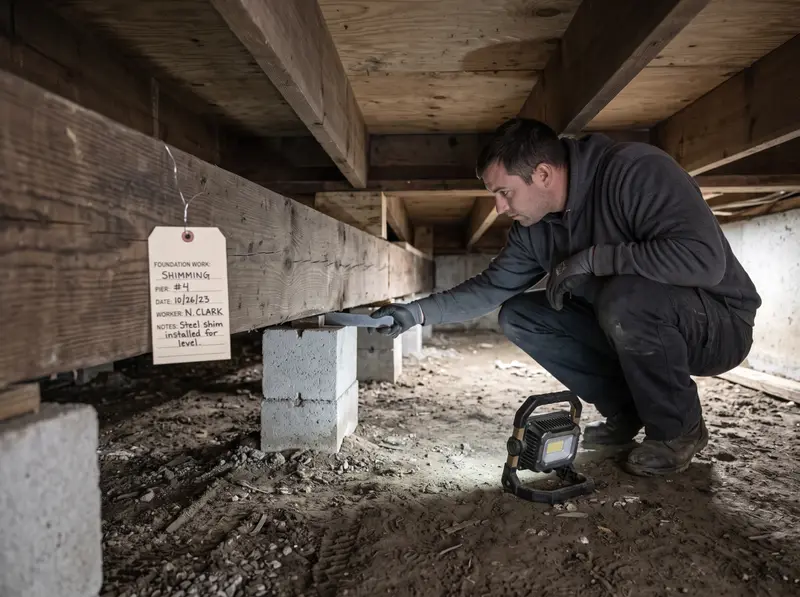
Piers reliably carry load on ground below the moving layer, and that part is well established. What varies is whether the untreated ground around them keeps swinging, which is what produces new symptoms after a repair.
The mechanism a Houston repair has to work against
Up to 51% clay in the mapped soil, rated Somewhat poorly drained for drainage. That combination is the mechanism: water arrives, the clay takes it up and expands, the dry season pulls it back out and the volume falls. Support addresses where the house has already gone. Only drainage addresses where the ground is going next, which is why the two belong in one scope.
The reasoning behind that
Take the question in two halves. Can a column bearing on competent ground hold up a section of house? Yes, and that is not controversial — it is ordinary structural engineering and it has been done for a very long time. Does installing that support stop the house moving? Not by itself, because the mechanism that moved it is moisture in the soil and a pier does not change the moisture. Supporting part of a structure while the rest continues to ride the seasonal swing can increase the differential, which is how a repair produces new cracking. The repairs that hold up over time pair the two: support where the movement has already occurred, and moisture management so the rest stops swinging as far. The second half is the cheap half and the most commonly skipped. When people say foundation repair did not work, the scope is usually what failed rather than the piers.
Every question, in one place: Houston Foundation Repair Co questions.
Check the Houston Foundation Repair Co service area to see whether your street is covered.
Back to Houston Foundation Repair Co.