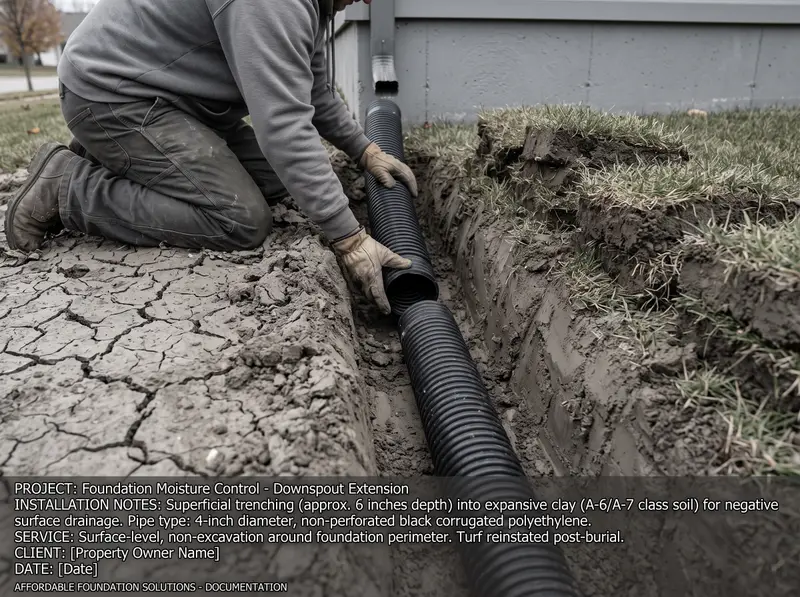
Excavation in saturated clay produces spoil that will not go back and readings that do not reflect the dry-season position of the house. Work is commonly paused not for comfort but because the results are worse.
How wet Houston ground gets
A ten-year storm here drops 8.7 inches in twenty-four hours, and up to 5% of the mapped ground is rated as susceptible to ponding. Those two figures are the reason scheduling matters more in this trade than it looks like it should: the same excavation is a different job depending on which week it happens in.
The reasoning behind that
Wet clay is the problem, not the rain. Excavated saturated clay loses its structure, comes out as something closer to slurry, and cannot simply be replaced and compacted. That turns a tidy backfill into a spoil-removal job and a settled backfill later. Readings taken in a wet period describe a house at its most swollen position. Lifting to that position and then watching the ground dry out through summer is a way of building the next problem into the repair. Some work is genuinely weather-independent — interior piers under a roof, crawl space framing, injection work in a dry basement. Ask which category your scope falls into rather than assuming the whole job stops. A firm that offers to proceed regardless in heavy rain is worth a question about why. Sometimes there is a good answer; sometimes it is a schedule being protected at the cost of the result.
Every question, in one place: Houston Foundation Repair Co questions.
Check the Houston Foundation Repair Co service area to see whether your street is covered.
Back to Houston Foundation Repair Co.