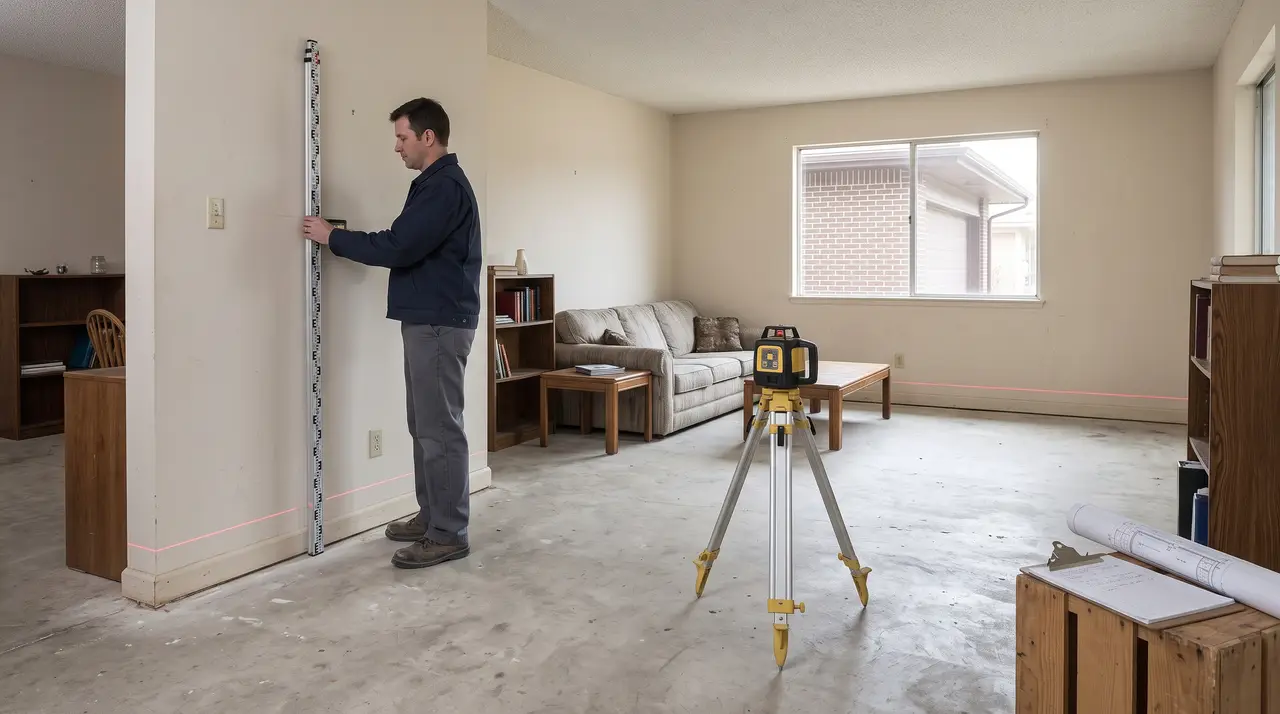
Call someone who measures before you call anyone who repairs. A foundation inspection or elevation survey turns a list of symptoms into a number, and every useful conversation after that starts from the number.
What you are actually looking at
Symptoms cluster, and the cluster is more informative than any single item. Doors and windows that stick on one side of the house, cracks running diagonally from the corners of door frames, a gap opening between the skirting and the floor, and a floor that feels like it falls away as you cross a room are all the same finding described four ways: one part of the structure is at a different height from another part. A single symptom on its own is much weaker evidence. A door sticks in humid weather because the door swelled. One hairline crack in a garage slab is what concrete does as it cures. Neither is worth a phone call on its own. What nobody can tell you from a photograph is whether it is still moving, and that is the only question that decides what to spend. A crack that has been the same for five years and one that opened last spring look identical in a picture.
Which trade to call first, and why it is not the repair one
Four trades will take this call. A foundation repair contractor will measure and quote a repair. A structural engineer will measure and issue an opinion without selling the work. A general home inspector will note it and refer you on. A plumber will test whether a leak under the slab is what saturated the ground in the first place. Call whoever measures, first. The order matters because every one of the others gives better advice once there is a survey in hand, and because a quote built without one is a quote for a house nobody has measured. If a lender, an insurer or a buyer has asked you for something in writing, ask exactly what they want before you buy anything. A contractor’s report and a licensed engineer’s stamped letter are different documents, they cost different amounts, and only one of them will close the file that has been opened.
What to have ready before you call anyone
Three things make the first conversation useful and all of them are free. Dated photographs of each crack with something for scale in the frame, taken today, so that a second set in three months means something. A note of when you first noticed each symptom, because the timeline separates a house that moved once from a house that is moving now. And any history of plumbing leaks, drainage changes, tree removals or new construction next door within the last few years. If there is a survey or an inspection from when you bought the house, find it. A previous set of elevations is worth more than anything you can buy today, because it is the one thing that turns a single reading into a rate of movement. Write down what you actually want to end up with, too. Knowing whether the house is safe, satisfying a lender, negotiating a price and stopping further movement are four different objectives and they buy four different things.
When not to buy anything yet
There are three situations where the right next step costs nothing. The first is a single new symptom with no others: photograph it, date it, and look again in three months. Movement that matters rarely announces itself once and then waits politely. The second is immediately after a drought or an unusually wet season. Clay moves with the weather, and some of what a dry summer opens will close again. Measuring through that swing is what separates seasonal movement from progressive movement, and only the second one needs piers. The third is when someone has quoted a repair without measuring anything. That is not a price, it is an estimate of what houses like yours usually cost, and it is the one situation on this page where getting a second opinion is not caution but arithmetic.
When not to buy one
Water on the floor after a heavy rain, near one wall, with a downspout outside it. Fix the downspout first. Water that seeps through a wall in a wet spring and never in summer. Look at the grade first. A drain installed around either of those is money spent on the wrong cause.
Two checks worth making before anyone quotes you.
- Extend the downspouts. A roof outlet should discharge at least 6 feet from the wall, and 10 is better. One downspout can put hundreds of gallons against a footing in a single storm, and an extension costs a small fraction of a drain.
- Fix the slope. The ground in the first 10 feet should fall away from the house, about 6 inches over that distance. Where it falls toward the house instead, water is being delivered to the wall on purpose.
If either is wrong, correct it and watch one more storm before spending anything larger.
Read what a Houston foundation repair job costs before calling anyone, and check the Houston Foundation Repair Co service area to see whether your street is covered.
Back to Houston Foundation Repair Co.
Questions people actually ask
Are all foundation cracks serious?
No, and most are not. Concrete cracks as it cures and as it takes up load. What separates a serious crack from an ordinary one is whether it is growing and whether the floor behind it has changed height, neither of which is visible in a photograph.
How much does foundation repair cost?
Published cost guides put the range at roughly 2,225 to 8,135 US dollars nationally, and the range is the honest answer rather than a midpoint. What decides where a specific house lands is the number of support points and whether any of them are inside.
Does insurance cover foundation repair?
It depends entirely on the cause, and cause is what an inspection establishes. Policies commonly treat sudden events differently from gradual movement, and a claim usually turns on which one the evidence supports. Read the policy and ask the insurer directly.
Will foundation problems stop a house from selling?
They change the conversation rather than ending it. What buyers and lenders react badly to is an unquantified problem, which is why a measurement in hand is usually worth more than a repair half done.
Should I fix the cracks before selling?
Ask what the buyer will be told. Cosmetic repair that hides movement without addressing it is a disclosure problem as well as a structural one, and a documented measurement is often a better asset than fresh mortar.
Trusted across Houston, Texas and Harris County
What this site is good for
-
Residential and commercial
A house with a wet basement and a site with standing water on a hardstanding are different jobs at different scales. Both are covered, and the pages say which is which.
-
Free, and nothing attached
Working out which job you actually have costs nothing and commits you to nothing. There is no fee to you at any point, because this site is paid by the contractor and not by you.
-
Your details are not for sale
An address sent here goes to a foundation repair contractor working in the area. It is never sold, and never passed to a second firm.
-
Permits named, not glossed
The pages name the authority that issues the permit for this work and the inspection that goes with it, so you can ask to see one before the first cut.
-
Every figure sourced and dated
Soil, rainfall and housing figures each name where they came from and when they were retrieved. Where a published estimate carries a margin of error, the margin is shown too.
-
One town, covered properly
This site is about one place and the towns within a short drive of it. It is not a national directory with a city name dropped into a template.
-
An open pier cut past the slab edge. How deep it has to go is decided by the ground, not by the house. -
The lift itself, read off a dial indicator. Deciding where to lift is the part that takes the measuring.


Ground that is saturated has nowhere to put the next storm, and water sitting against a wall keeps working on it.
What happens after you send an address
-
The address first, and only then who you are
The first screen asks for the property address and checks that a contractor covers it. Only if one does does it ask for a name, a phone number and an email — there is no point taking your details to tell you nobody serves your street.
-
Your details are not for sale
It goes to a foundation repair contractor working in Houston. The details are never sold, and never passed to a second firm.
-
No cost, and nothing attached
There is no fee for sending an address and no obligation that follows from it. Deciding the work is the wrong work is a perfectly good outcome.
-
Who does the work
An independent foundation repair contractor, not the publisher of this site. Who runs this site, and where every figure on it comes from, is set out on the about page.